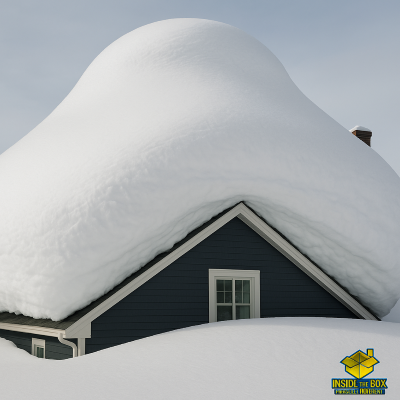
7 Things
Your Snow-Covered Roof
Is Trying to Tell You
This Winter
Table of Contents
Not written by an outside marketing company.
This is written by Owner & Inspector John, want some proof?? Ai would never type this “hu433^%sofh98ewsyhtrfiuo4ewhfg&89snelkjs“.
There ya’ go.
(A brutally honest guide from a Michigan home inspector who actually crawls into attics for fun… sort of.)
Winter shows up in Michigan like it owns the place. Snow everywhere. Salt everywhere. Your car looks like a powdered donut. And your roof suddenly becomes a giant billboard telling the entire neighborhood how well your attic insulation is doing.
Most people never notice it, but once you see it, you can’t unsee it.
So let’s break it down… with numbers, because apparently the human brain loves that.
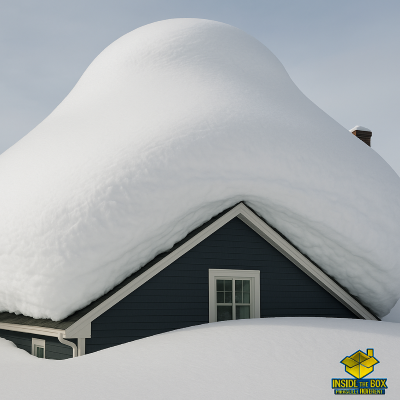
1. The 24-Hour Rule
If you get a fresh blanket of snow and your roof is almost bare within 24 hours, while your yard still looks like Narnia, congratulations.
Your attic is basically a space heater you didn’t ask for.
Heat is escaping into the attic, warming the roof deck, and melting the snow.
Which leads us to…
2. The Even-Snow Test
Snow should melt evenly.
If the roof looks like it has bald spots, hot patches, or weird streaks, it’s usually insulation gaps or air leaks.
Think of it like a hairline. Uneven patterns are rarely good news.
3. The Striping Effect
(Episode VII: The Rafters Strike Back)
Ever see parallel melted stripes running up and down a roof?
That’s heat transferring through the rafters.
It’s a textbook sign that the attic needs better insulation or air sealing.
Your roof is basically screaming “Help me” in Morse code.
4. The Ice Dam Temperature Range: 32 to 38 Degrees
Ice dams happen when the lower edge of the roof gets warm enough to hit 32–38°F.
That warmth is coming from inside your home.
Your furnace is out here melting snow like it’s auditioning for a job at Dairy Queen.
Ice dams can cause leaks, rot, mold, attic damage, and lifelong rage.
5. Heat Loss Can Increase Winter Bills by
10 to 25 Percent
Look, I don’t like paying bills either.
But throwing extra money at Consumers Energy because your attic is leaking heat is like tipping a server who didn’t even show up to your table.
Fixing insulation issues saves real money.
This isn’t HGTV fluff. It’s physics.
6. Michigan Attics Should Have
R-49 to R-60 Insulation
If you pop your head into the attic and your insulation looks like a sad, thin blanket from a motel, it’s not enough.
You want around R-49 to R-60, depending on your house.
This is one of the cheapest upgrades with the biggest ROI.
7. A Roof Temperature Difference of 3 to 15 Degrees Will Melt Snow Early
A tiny heat leak can warm your roof by just a few degrees and melt snow days before your neighbors’ roofs even start dripping.
Small air gaps and insulation gaps = unnecessary heat loss = higher bills = snow disappearing early.
So What Does This Mean for Homeowners?
Your roof might be tattling on your house.
If the snow melts too fast or in weird ways, it’s usually not a roofing problem.
It’s an attic and insulation issue.
And the good news is… these are fixable problems.
How This Helps You as a Home Buyer or Homeowner
Here’s the part where I channel my inner salesperson, but like, the non-annoying kind.
A roof that melts fast can signal:
- Poor attic insulation
- Air leaks
- Ventilation problems
- Ice dam risk
- Higher heating bills
- Moisture issues
- Mold potential
And you know who checks for all of that?
A very handsome, very tired, very caffeinated Michigan home inspector who owns Inside the Box Home Inspections.
Want This Checked Professionally?
I use thermal imaging, attic inspections, and roof/ventilation assessments to tell you exactly where your heat is escaping and what it means for your home.
Book online anytime here:
https://insidetheboxhomeinspections.com/book-an-inspection-online/
Or if you have questions, message me here:
https://insidetheboxhomeinspections.com/contact-inside-the-box/
Here’s some info from the Department of Energy about insulation.