
What is a WDO (Wood Destroying Organism) Inspection?
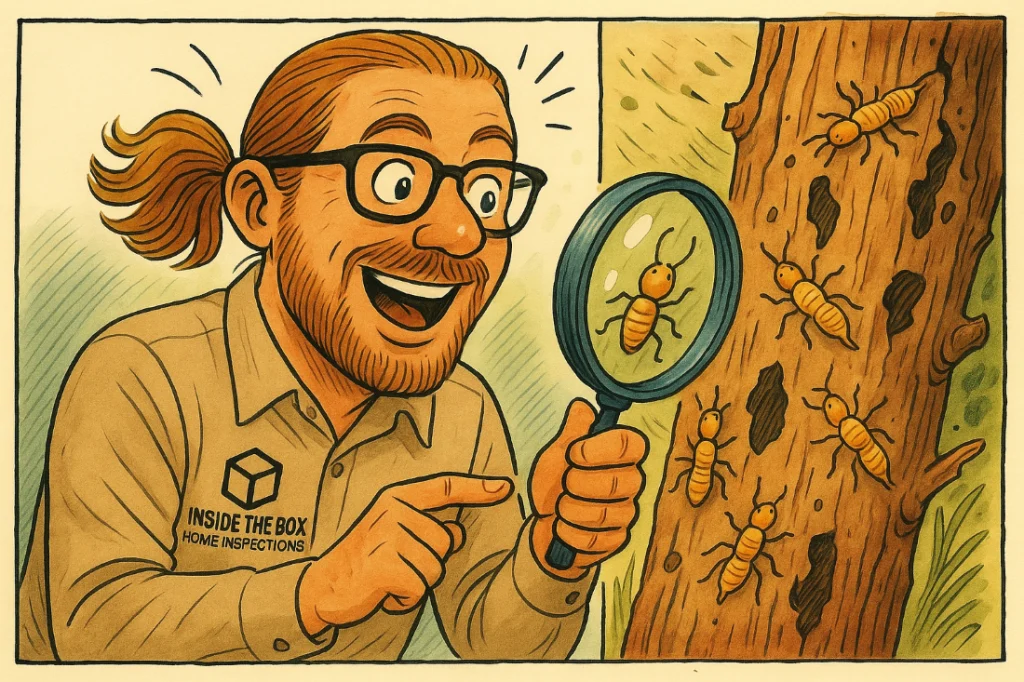
Wood-destroying organisms include termites, carpenter ants, carpenter bees, and wood-boring beetles can quietly eat away at a home’s structure until serious (and expensive) damage shows up.
Some lenders, especially VA, require a WDO inspection before closing.
Inside the Box offers thorough WDO inspections that look for active infestations, past damage, and conditions that invite future problems (like wood-to-soil contact or excessive moisture).
We check attics, crawlspaces, basements, and structural wood members, documenting any evidence with photos.
WDO Inspection
- NPMA-33 form completed for VA, FHA, USDA and other lenders
- Visual inspection plus targeted moisture checks at suspect areas
- We use moisture meters and borescopes where necessary and accessible
- Findings categorized per form requirements with treatment or reinspect notes if needed
- Fast turnaround for agent and lender uploads
- Same NPMA-33 loan documentation without a full home inspection
- Targeted moisture checks, photos, and plain-language summary
- Direct delivery to you and your agent or lender
When needed, we use probing tools, moisture meters, and thermal imaging to help spot hidden issues.
If problems are found, your report will clearly outline what we saw and whether further treatment by a licensed pest control contractor is recommended.
Type 1 Bundle Add-On Testing Baseline screenings that stack smart. Bundles are a thank you for choosing Inside the Box. Click to expand Click to collapse
What’s in Type 1
- Radon: 2 charcoal canisters, lab analysis
- Mold and IAQ Snapshot: 2 air samples, spore ID and levels
- Essential Water Check: screening for coliform, nitrates, nitrites
- WDO for Loans: visual plus targeted moisture
- Well System Check: head, cap, casing, tank review
- Septic Dye Screening: noninvasive dye and load
- Sewer Scope: main line camera up to 100 ft
- Pool and Spa: visual, function, safety notes
Single Type 1 screening
Choose any one Type 1 test.
Popular value combo
Pick any two Type 1 tests. Suggested pairs: Mold + Sewer or Water + Radon or Well + Septic.
Balanced coverage
Pick any three Type 1 tests. Typical trio: Radon + Mold and IAQ + Essential Water.
Wide net for surprises
Pick any four Type 1 tests. Common mix adds a systems check like Well, Septic, or Sewer Scope.
Keep stacking without full price
Add as many as you want at the add-on rate. Examples: round it out with Pool and Spa or WDO.
How bundles work
Type 1 screenings are fast snapshots that surface issues.
If results or site conditions suggest more complexity, I recommend targeted Type 2 testing so you get real answers instead of guesswork.
On-site findings are usually same day. Lab timing varies by test.
Smart upgrade pricing
Upgrade credit: if we move from a Type 1 to a deeper Type 2, every dollar already paid is credited. You pay the difference only. No restart tax.
When upgrades make sense:
- Lab flags or on-site readings suggest more detail
- Loan or insurance needs stricter documentation
- Health concerns or water quality red flags
- Agent or buyer wants deeper due diligence
Fair-play policies
- Free remediation re-test within 3 years
- If a lab result is inconclusive for no clear reason or due to my obvious error, I re-test at no cost
- Add-on results don’t carry the $100 same day guarantee for the main inspection
- Most on-site findings are same day. Lab results are typically 1 to 3 business days
- No trip fees ever
- If access is denied after you’ve paid, I’ll find an alternative or refund or switch the test
Type 2 Bundle Add-On Testing
Mix and match any Type 2 test. Type 2 includes everything in Type 1 plus more. Upgrade credit applies when we move from Type 1 to Type 2 during the same appointment.
Click to expand
Click to collapse
Type 2 Bundle Add-On Testing
1 Test
2 Tests
3 Tests
4 Tests
What’s in a Type 2 Test? Click to expand Click to collapse
WDO (Wood Destroying Organism) Inspection FAQ
Termites aren’t the only wood-destroying threat in Michigan homes. Here are the most common questions buyers ask before scheduling a WDO inspection.
A WDO inspection looks for wood-destroying insects and conditions that may attract them. This includes termites, carpenter ants, carpenter bees, wood-boring beetles, and fungus or moisture conditions that damage wood. The inspection also includes the official NPMA-33 form for real estate transactions.
Yes, we do. Eastern Subterranean Termites are found throughout Michigan. They aren’t as aggressive as southern species, but they absolutely cause structural damage when not caught early. Carpenter ants and wood-boring beetles are also major concerns here.
I look for evidence of: • termites • carpenter ants • carpenter bees • powderpost beetles • other wood-boring insects • wood decay fungus • high moisture that could lead to wood rot • structural damage tied to insect activity The goal is to detect active issues and the conditions that cause them.
The NPMA-33 is the official inspection form required for most real estate transactions, especially FHA/VA loans. Yes, you receive the completed NPMA-33 with every WDO inspection I perform.
I look for mud tubes, frass (insect droppings), bore holes, sawdust piles, damaged wood, hollow-sounding wood, swarmers, galleries, moisture issues, and conditions conducive to infestation. Sometimes the insects hide, but the damage doesn’t.
No. I do the inspection and provide documentation. Treatment must be performed by a licensed pest control company. I can help you understand what type of treatment is needed and how urgent the issue is.
Most WDO inspections take around 30 minutes to an hour depending on the size of the home and accessibility. When paired with a home inspection, everything is streamlined.
Yes. Many FHA, VA, and USDA loans require a WDO inspection and NPMA-33 form. Some conventional loans require it when certain conditions exist, like moisture problems or crawlspaces.
Not always. The inspection is visual and non-invasive. But I can often identify hidden issues based on patterns, structural clues, staining, moisture readings, and insect behavior. If needed, I recommend next steps or further evaluation.
You receive a detailed report and NPMA-33 form noting the findings. I explain the severity and what type of licensed pest company should address it. You can use this information to negotiate repairs or treatment with the seller.
Need a WDO inspection or have questions about bugs or wood damage?
Click here to find out more from the EPA about Termites and other WDO.